Step into the microscopic world of advanced physics where two luminescent champions compete to light up the future. Follow Lumos, a brilliant photon engineer, as he dissects the structural secrets, charge balances, and energetic battles that separate the legendary efficiency of OLEDs from the dynamic challenges of LECs. A captivating scientific journey that transforms complex material science into a visually stunning epic of light.
Lumos stands before a massive glowing laboratory console, projecting the blueprint of two rival light-emitting technologies. With a flick of his wrist, he initializes a high-resolution simulation comparing a highly structured architecture against a single-layer dynamic film. The air crackles with energy as holographic streams of blue electrons and red holes begin to flow.
Focusing on the first panel labeled OLED, Lumos reveals a meticulously organized fortress of five distinct layers stacked perfectly on top of each other. He points out how the orderly rows of the Hole Transport Layer and Electron Transport Layer guide the incoming charges with absolute precision toward the central Emissive Layer. The entire structure radiates a sense of absolute stability and predictable engineering.
Within the OLED fortress, streams of blue electrons from the cathode and red holes from the anode march forward at perfectly synchronized speeds. They converge flawlessly right at the center of the Emissive Layer, creating a perfectly balanced zone of charge injection. Lumos smiles as he watches the two opposing forces meet in perfect harmony, with no single charge wasted or left behind.
Right at the heart of the OLED, a narrow, glowing green band solidifies into a fixed recombination zone that never shifts or wavers. Inside this steady green sanctuary, electrons and holes lock arms to form stable excitons, releasing brilliant, uninterrupted flashes of pure light. Lumos notes the high, consistent external quantum efficiency represented by a bold, bright green check mark hovering above the structure.
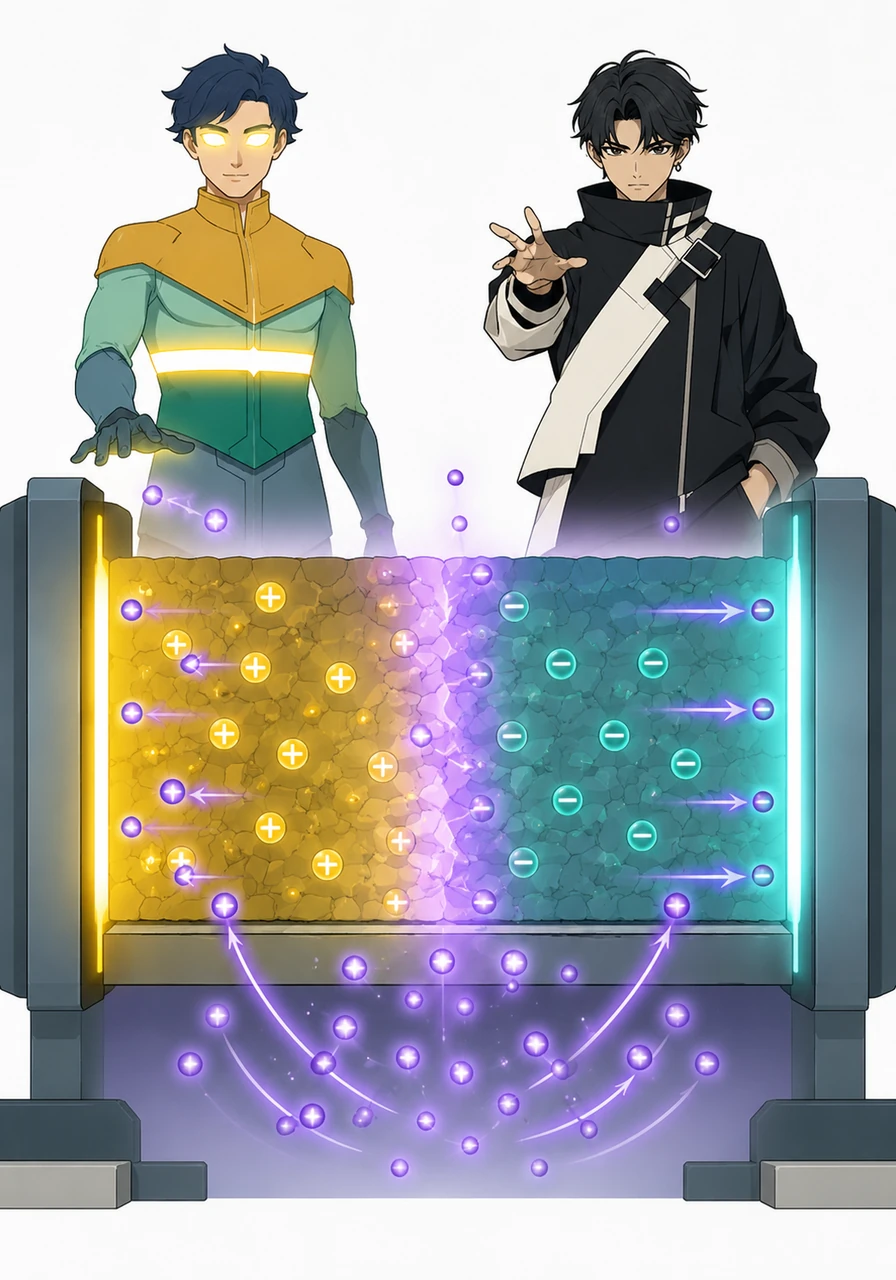
Lumos turns his attention to the second panel labeled LEC, where a single, unorganized layer of emissive film sits between two simple electrodes. Unlike the rigid OLED, this film is filled with restless, floating spheres representing mobile cations and anions that drift freely through the material. The moment an electrical bias is applied, the ions begin to scramble toward opposite sides of the chamber in a chaotic dance.
As the ions migrate under the electric field, they accumulate near the electrodes, spontaneously forcing the single layer to transform. On one side, a p-doped region materializes, while on the opposite side, an n-doped region develops, forming a dynamic, in situ p–n junction right in the middle of the chaos. Purple arrows trace the paths of these moving ions as they aggressively reshape their own environment.
Unlike the steady OLED, the recombination zone inside the LEC manifests as a broad, blurry mist that drifts unpredictably back and forth across the layer. The dynamic electrochemical doping fronts push and pull the zone, making it impossible for the incoming charges to find a permanent, stable home to unite. Lumos watches closely as the boundaries shift constantly, creating pockets of instability.
Disaster strikes within the shifting LEC layer as the balance of charges completely breaks down, leaving stray electrons and holes isolated. Because the recombination zone drifts too close to the active doping fronts, the newly formed excitons crash into roaming ions and get snuffed out prematurely. Lumos documents these non-radiative losses as orange and red warning symbols flare up across the quenching sites.
Lumos activates a side-by-side comparison matrix, highlighting the dramatic contrast between the two glowing systems. The OLED maintains its serene, high-efficiency green glow due to its fixed recombination zone, while the LEC flickers unevenly under a warning orange aura brought on by charge imbalance and ion drift. The data streams side by side, clearly illustrating the origin of the massive quantum efficiency gap.
Bringing his analysis to a close, Lumos projects a definitive central conclusion box that bridges both architectural diagrams. The text solidifies to declare that while OLEDs achieve peak performance through stable charge balance and fixed zones, LECs face inherent efficiency limits due to their reliance on volatile ion transport. With the scientific mystery solved, Lumos saves the schematic into the master review journal, illuminating the path forward for advanced materials.
مطالبة التوليد(سجّل الدخول لرؤية المطالبة الكاملة)
Create a high-resolution scientific schematic comparing the operating mechanisms of OLEDs and LECs to explain the origin of the external quantum efficiency (EQE) gap. Layout: Split the figure into two side-by-side panels labeled (a) OLED and (b) LEC. Panel (a): OLED Show a conventional multilayer OLED architecture consisting of Anode / Hole Transport Layer (HTL) / Emissive Layer (EML) / Electron Transport Layer (ETL) / Cathode. Illustrate balanced electron and hole injection from opposite electrodes. Depict a narrow, fixed, and well-defined recombination zone centered within the emissive layer. Show exciton formation confined to the stable recombination zone. Use arrows to indicate efficient charge transport and radiative recombination. Add labels: “Stable multilayer architecture”, “Fixed recombination zone”, “Balanced charge transport”, “Efficient exciton formation”. Include a green check mark and annotation: “High and consistent EQE”. Panel (b): LEC Show a single-layer emissive film containing mobile cations and anions between two electrodes. Illustrate ion migration toward opposite electrodes under applied bias. Show formation of p-doped and n-doped regions, creating an in situ p–n junction. Depict a broad and shifting recombination zone. Include arrows indicating dynamic ion transport and electrochemical doping fronts. Show exciton quenching sites and non-radiative loss pathways. Add labels: “Mobile ion migration”, “Electrochemical doping”, “Dynamic p–n junction formation”, “Recombination-zone drift”, “Charge imbalance”, “Non-radiative losses”. Include a yellow/orange warning symbol and annotation: “Lower EQE”. Bottom Summary: Place a central conclusion box connecting both panels: “OLEDs achieve high EQE through stable charge balance and a fixed recombination zone. LECs rely on ion-mediated electrochemical doping and dynamic recombination-zone formation, leading to charge imbalance, exciton quenching, and reduced EQE.” Style: Professional Nature/Advanced Materials journal style. Clean vector graphics with publication-quality labels. Blue arrows for electrons, red arrows for holes, purple arrows for ion migration. Use green glow for efficient radiative recombination and orange/red symbols for loss mechanisms. White background, minimalist design, suitable for a review article or graphical abstract.