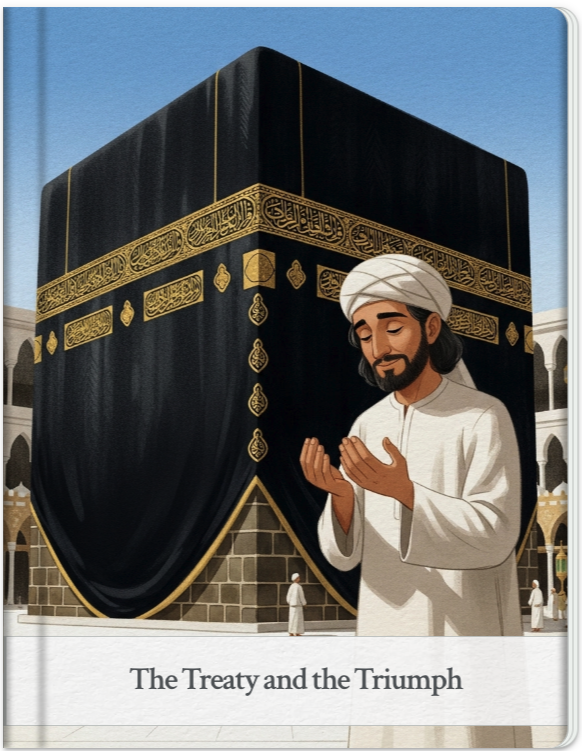
In the sixth year after theirmigration, the hearts of theMuslims in Medina yearned forMakkah. Led by Prophet Muhammad,a peaceful caravan of 1,400 believersdressed in the simple white cloths ofpilgrimage, set out not for battle, butfor prayer at the holy Kaaba. Theironly weapons were their faith andtheir love for God.
مطالبة التوليد(سجّل الدخول لرؤية المطالبة الكاملة)
## Gemini Story Prompt: The Treaty and the Triumph Tell a story centered on the events of the **Treaty of Hudaybiyyah** and the subsequent **Conquest of Makkah**, focusing on the faith, tension, and ultimate victory of the early Muslim community. ### Key Story Elements: * [cite_start]**The Journey to Hudaybiyyah (Year 6 AH):** Begin with **Prophet Muhammad** and **1,400 Muslims** leaving Medina for Makkah to perform **Umrah** (minor pilgrimage)[cite: 6]. [cite_start]Emphasize their peaceful intent, even as they encounter resistance from **Khalid bin Al-Walid's** army, forcing them to take a detour to the well of **Hudaybiyyah**[cite: 7, 8]. * [cite_start]**The Pledge Under the Tree (Ar-Ridwan Pledge):** Narrate the moment of extreme tension when the Muslims mistakenly believe their envoy, **Uthman ibn Affan**, has been murdered by the Quraish[cite: 12]. [cite_start]Describe the profound scene where the companions collectively make a **pledge of allegiance (Bai'a)** to the Prophet, vowing to **fight to the death**[cite: 12]. [cite_start]Include the Prophet's emotional response and the sense of divine approval (**As-Sakinah** / calmness) that Allah granted them[cite: 21]. * [cite_start]**The Treaty of Hudaybiyyah:** Detail the negotiation and the perceived "humiliating" terms of the treaty[cite: 27, 44]. * [cite_start]**The key terms to include:** A **ten-year truce** [cite: 37][cite_start], the Muslims must return *without* performing Umrah this year [cite: 38][cite_start], and the controversial term of returning any Quraish person who comes to the Muslims without a guardian's permission (but not returning a Muslim who flees to the Quraish)[cite: 39, 41]. * [cite_start]Show the **disappointment and dissatisfaction** of many companions[cite: 44]. * [cite_start]Feature the wisdom of the Prophet's wife, **Umm Salamah**, whose advice to break their *Ihram* (ritual state) led to the entire community following suit[cite: 48]. * [cite_start]**The Manifest Victory:** Include the Prophet declaring the treaty a great **victory** [cite: 45][cite_start], which Allah Himself called a **"manifest victory" ($\text{Fathan Mubina}$) [cite: 51, 62][cite_start].** Highlight the long-term outcomes: an opportunity for peaceful **Dawah** (calling to Islam) and the eventual **Conquest of Makkah**[cite: 66, 75, 78]. * [cite_start]**The Conquest of Makkah (Year 8 AH):** Detail the Quraish's **breach** of the treaty[cite: 85]. [cite_start]Describe the **10,000-strong Muslim army** marching on Makkah during **Ramadan**[cite: 88]. * [cite_start]**Abi Sufyan's Conversion and Pardon:** Focus on the encounter with **Abu Sufyan**, who was granted safety for the Quraish[cite: 91]. [cite_start]Emphasize the Prophet's immense compassion, declaring that anyone who enters **Abu Sufyan's house**, or **closes their own door**, or enters the **Sacred Mosque** is safe[cite: 94]. * [cite_start]**The Triumphant Entry and Pardon:** Describe the Muslim army's entry with **minimal resistance**[cite: 98]. [cite_start]Focus on the **Prophet's humility** as he entered, reciting **Surah Al-Fath**[cite: 106]. [cite_start]End the story with the Prophet's great act of **pardon** for the inhabitants of Makkah and the subsequent **mass conversion** that cemented the fall of disbelief's "biggest fortress" in the Arab Peninsula[cite: 117, 123, 124]. *** [cite_start]**Tone and Focus:** The story should balance the themes of intense spiritual devotion, the complexity of political negotiation, the strength of faith in the face of doubt, and the ultimate triumph of **mercy and forgiveness** over revenge and retaliation[cite: 128, 129].