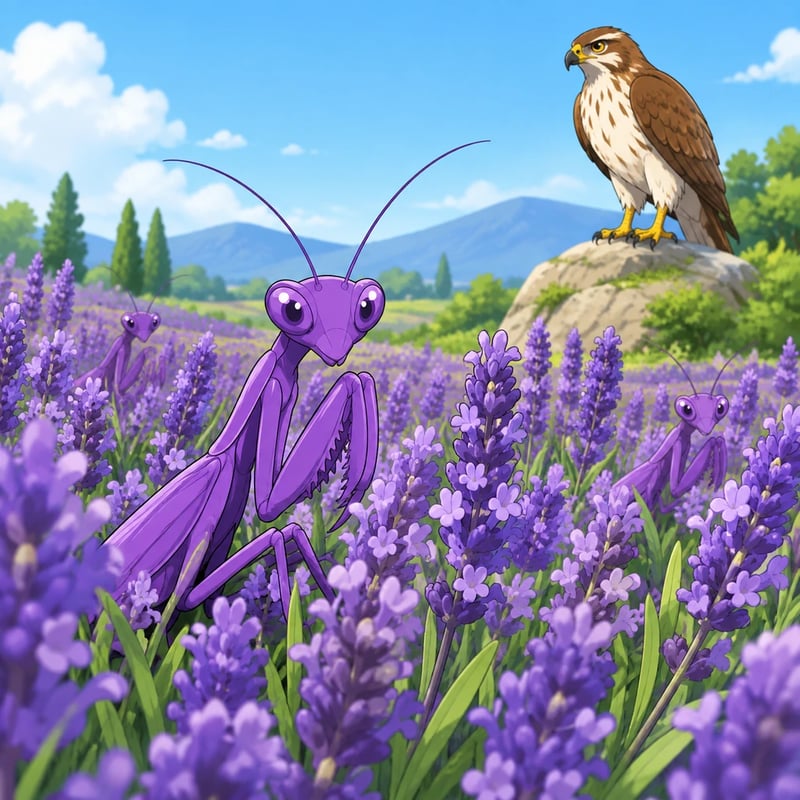
Join Pip the purple praying mantis on an extraordinary journey through a vibrant meadow of lavender blooms! Discover how natural selection works as Pip and her friends demonstrate how simple genetic traits can help a species thrive over generations. An engaging, illustrated science adventure that makes evolutionary biology fun and easy to understand for young minds.
Oluşturma İstemi(Tam istemi görmek için giriş yapın)
Create an 8-page illustrated science story about natural selection involving a population of praying mantises living in a large field filled with purple flowers. The mantises have natural colour variation. Some mantises are purple, while others are green, yellow, orange, and red. At the beginning, all colours are present in the population. A bird is the main predator. The bird hunts the mantises by looking for them among the purple flowers. The purple mantises naturally blend into the purple flowers, making them harder for the bird to see. The other coloured mantises are easier to spot and are more likely to be eaten. Make it clear that the purple mantises did not change colour because they wanted to survive. Purple colour already existed as a natural variation in the population. The environment simply gave purple mantises an advantage because they were better camouflaged. The surviving purple mantises reproduce more often and pass the purple-colour trait to some of their offspring. Over many generations, purple mantises become more common in the population while the other colours become less common. The type of natural selection shown in this story is DIRECTIONAL SELECTION. Clearly explain that directional selection occurs because one extreme variation of a trait, in this case purple colouring, is favoured by the environment. Show how the population shifts toward having more purple mantises over generations. Include these required graphs in the story: GRAPH 1: A bar graph showing the starting population of mantis colours before strong predation. Show approximately equal numbers of purple, green, yellow, orange, and red mantises. GRAPH 2: A bar graph showing the population after several generations. Purple mantises should have increased significantly, while green, yellow, orange, and red mantises should have decreased. GRAPH 3: A line graph showing the percentage of purple mantises increasing over multiple generations. Label the x-axis "Generation" and the y-axis "Percentage of Purple Mantises." The line should show a clear upward trend. Make the graphs simple, clearly labelled, and scientifically accurate. Use clearly stated illustrative numbers rather than pretending the numbers are real scientific data. Structure the story into exactly 8 pages. Each page should contain a short amount of age-appropriate narration and a clear illustration description. Suggested page structure: Page 1: Introduce the purple flower field and the different coloured mantises. Page 2: Explain that the different colours are natural variation within the population. Page 3: Introduce the bird predator and show that different mantises have different chances of being spotted. Page 4: Show that purple mantises survive more often because they blend into the flowers. Page 5: Show the surviving purple mantises reproducing and passing their colour trait to offspring. Page 6: Show the population changing over several generations and include Graph 1 or Graph 2. Page 7: Show that purple mantises are now much more common and include Graph 3. Page 8: Explain the natural selection conclusion and clearly identify it as directional selection. ALSO MAKE IT EASY TO DRAW