Join Monty Mirthful on a whimsical carnival adventure as he leads his boastful friend, Ferdinand Fizzy, on a quest for a legendary 'Amontillado.' This vibrant tale is packed with playful pranks, unexpected surprises, and a heartwarming lesson about friendship, all brought to life with cheerful colors and expressive characters.
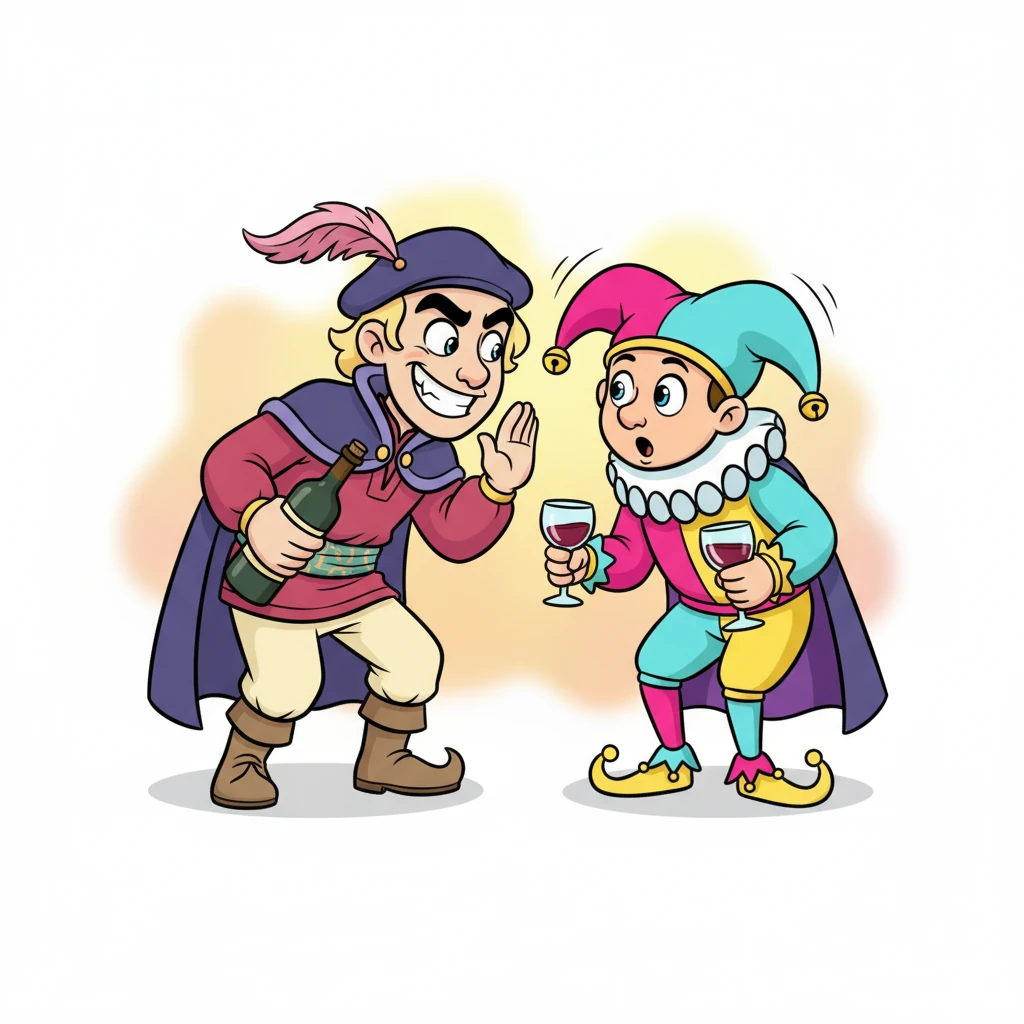
The grand carnival buzzed with joyous energy, a kaleidoscope of confetti and laughter. Amidst the swirling crowd, Monty Mirthful, a sprightly fellow with a mischievous grin, spotted his friend Ferdinand Fizzy, a flamboyant jester, boasting loudly about his incredible wine knowledge to anyone who would listen. Monty's eyes twinkled with a playful idea.
With a sly grin, Monty approached Ferdinand, whispering about a newly discovered, legendary "Amontillado" that was truly extraordinary. Ferdinand's exaggerated jester hat, adorned with jingling bells, bobbed excitedly as he leaned in, eager to prove his superior palate and uncover this mysterious vintage.
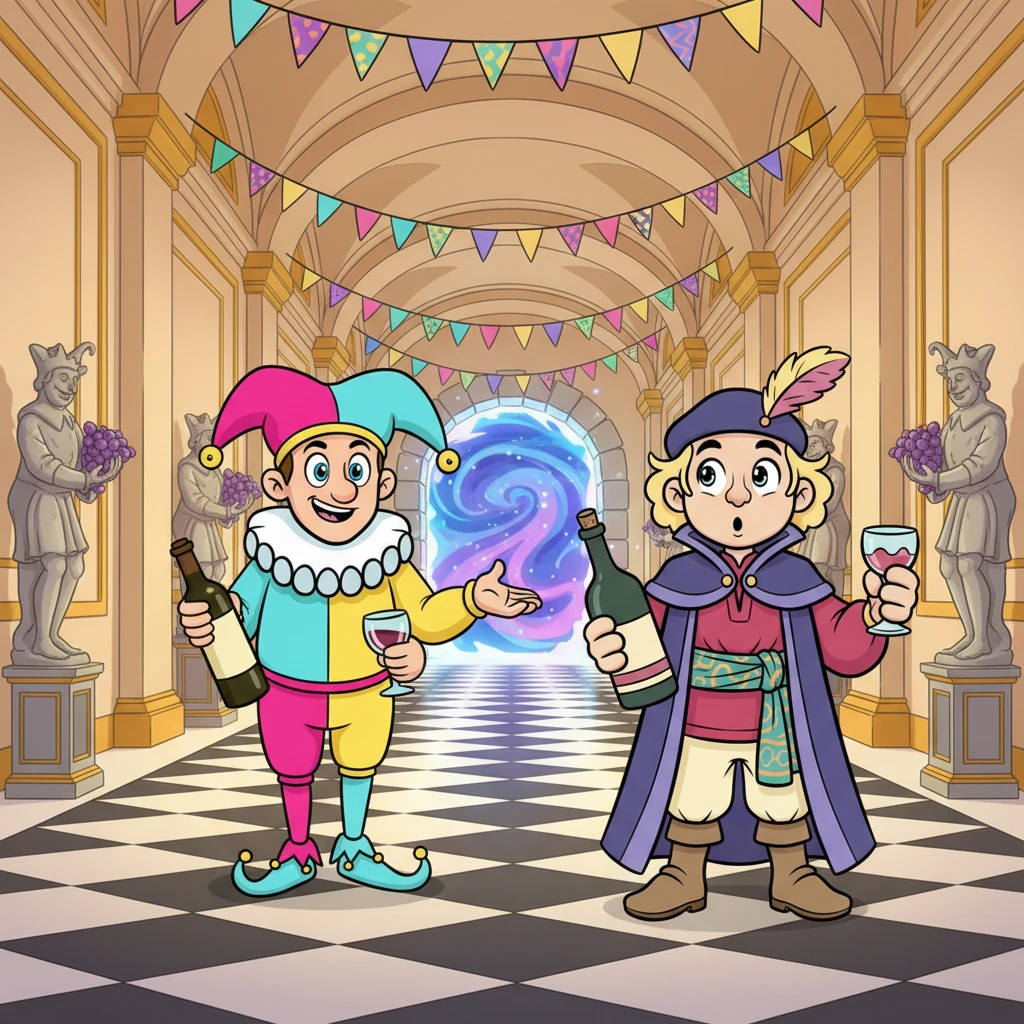
Monty led Ferdinand away from the carnival's hustle and bustle, through the grand, playfully decorated entrance of his palazzo. Whimsical statues and colorful banners lined the halls as they headed towards a mysteriously swirling archway. This archway promised to lead to the secret, special wine vaults, igniting Ferdinand's curiosity.
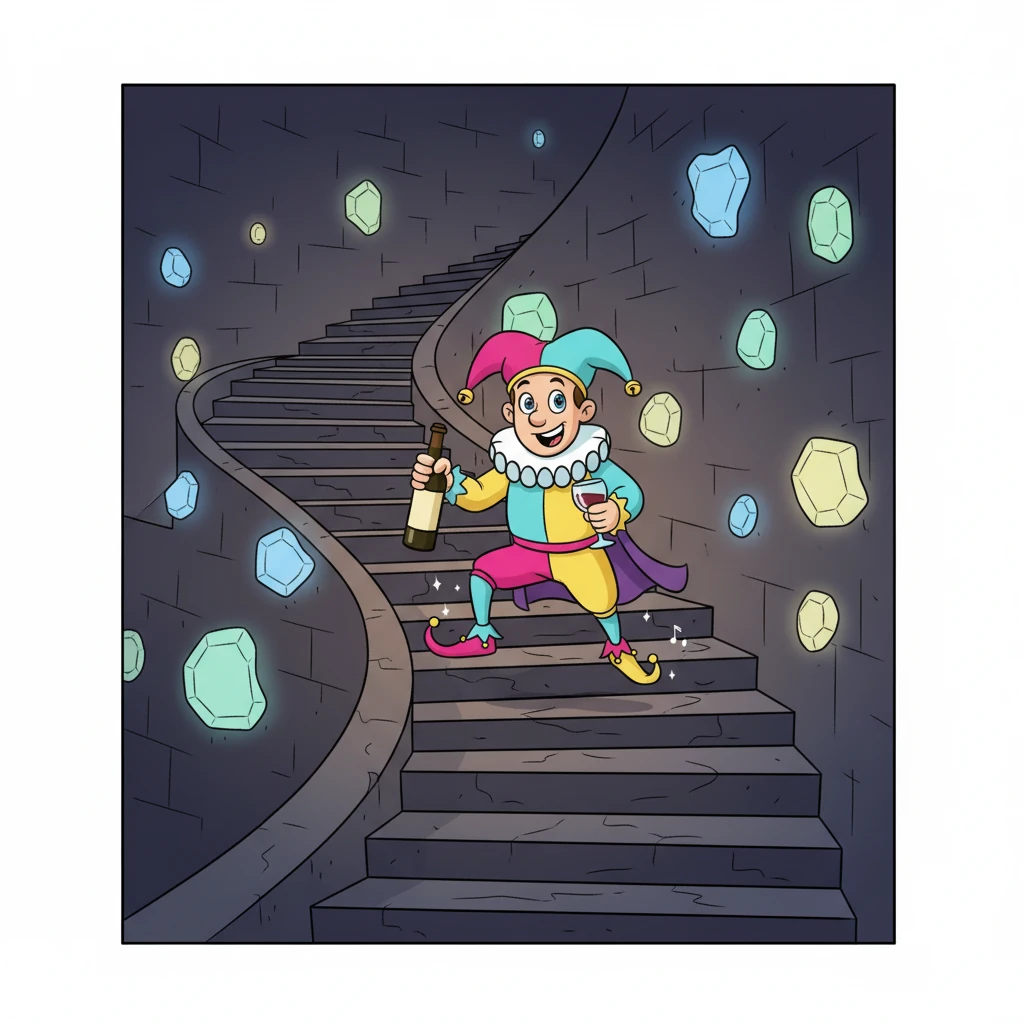
Down a long, winding staircase they went, into the playfully dim vaults, where friendly-looking, glowing "nitre" formations sparkled on the walls like tiny jewels. Ferdinand's bells jingled merrily with each bouncy step, adding a cheerful rhythm to their descent into the unknown depths.
Suddenly, Ferdinand let out a comical, exaggerated "Uggh-uggh-uggh!" cough, his chest puffing out like a proud pigeon. Monty, with a knowing wink, feigned deep concern, suggesting they turn back for Ferdinand's health. But Ferdinand, ever eager to prove his bravery and expertise, insisted they press on.
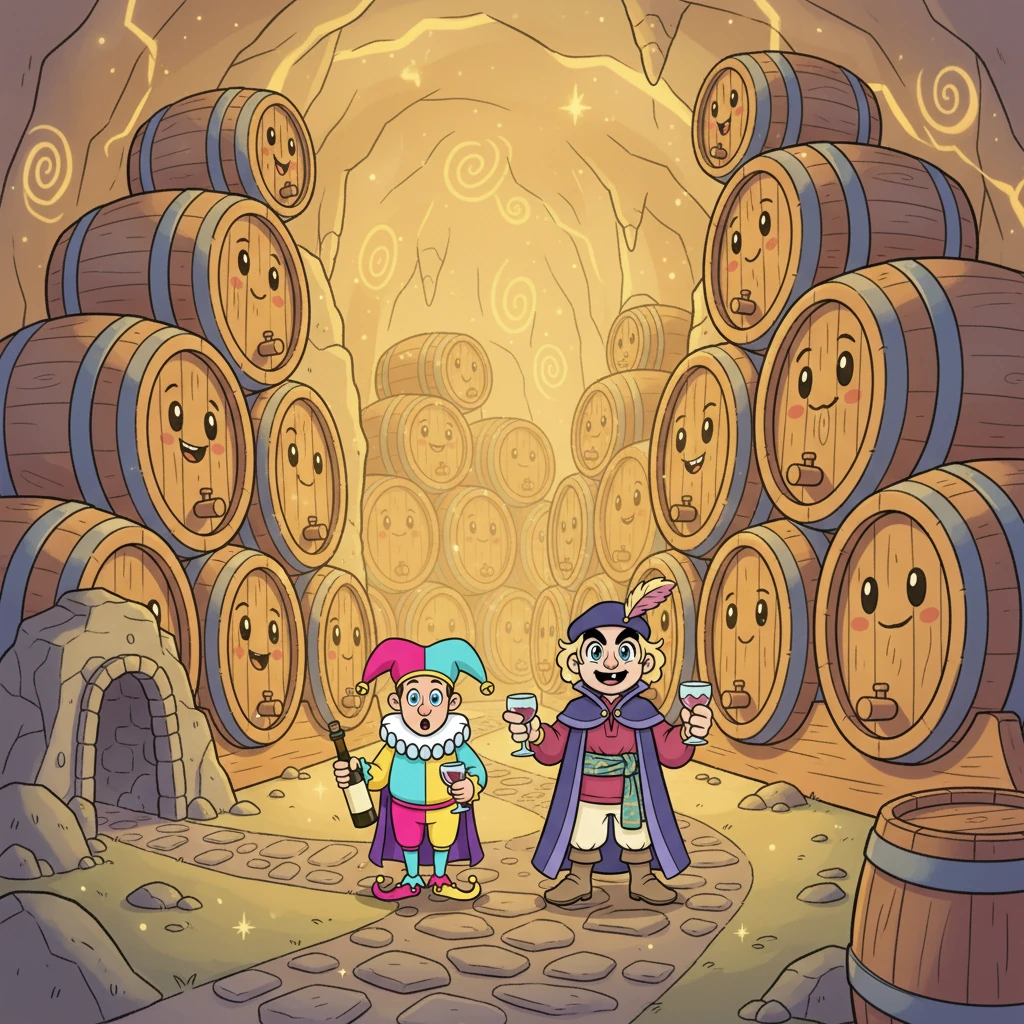
They ventured deeper into the twisting, turning tunnels, which eventually opened up into a vast, cavernous room filled with giant, cartoonish wine barrels stacked high. A soft, magical light emanated from the walls, illuminating their path and making the barrels glow with inviting warmth.
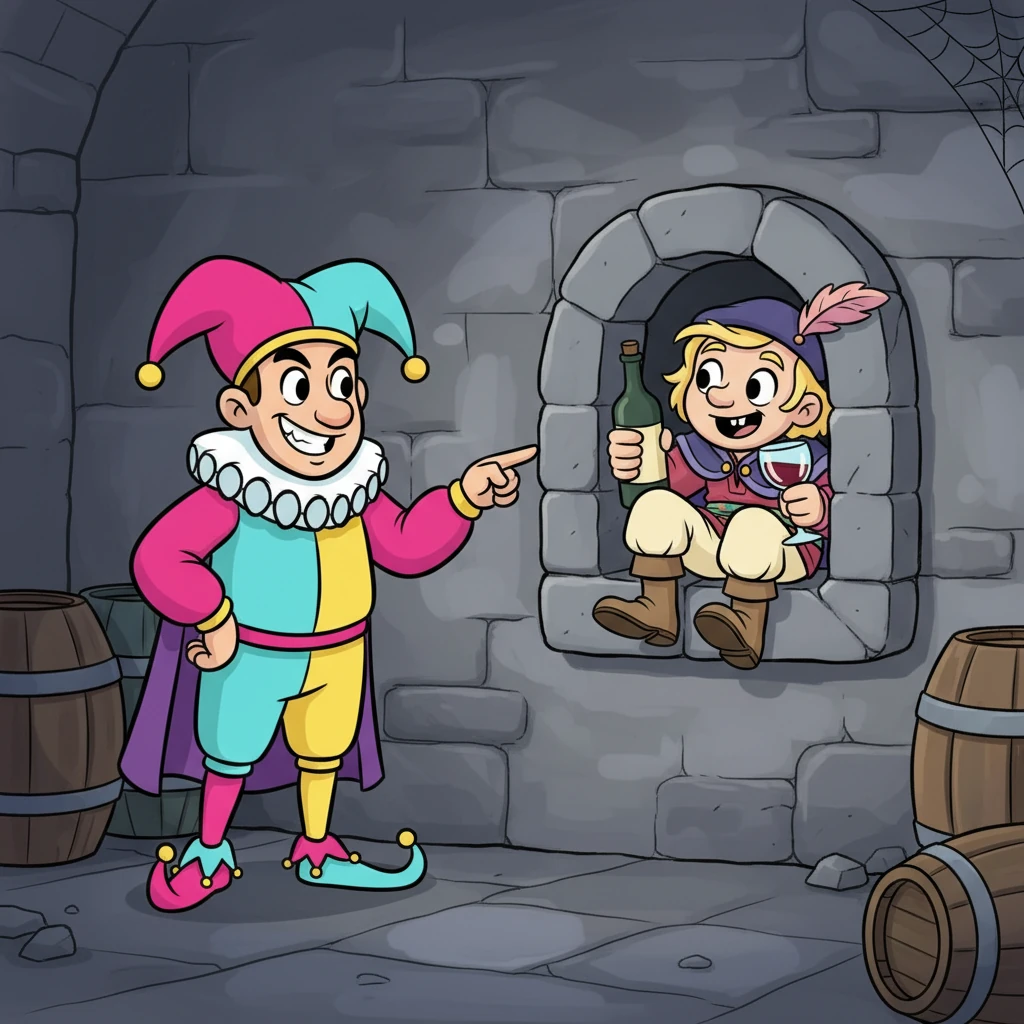
Monty then pointed to a small, cozy niche in the wall, just big enough for one person to squeeze into comfortably. Ferdinand, his eyes wide with anticipation and a hopeful smile, eagerly wiggled himself into the snug spot, convinced he was moments away from tasting the fabled Amontillado.
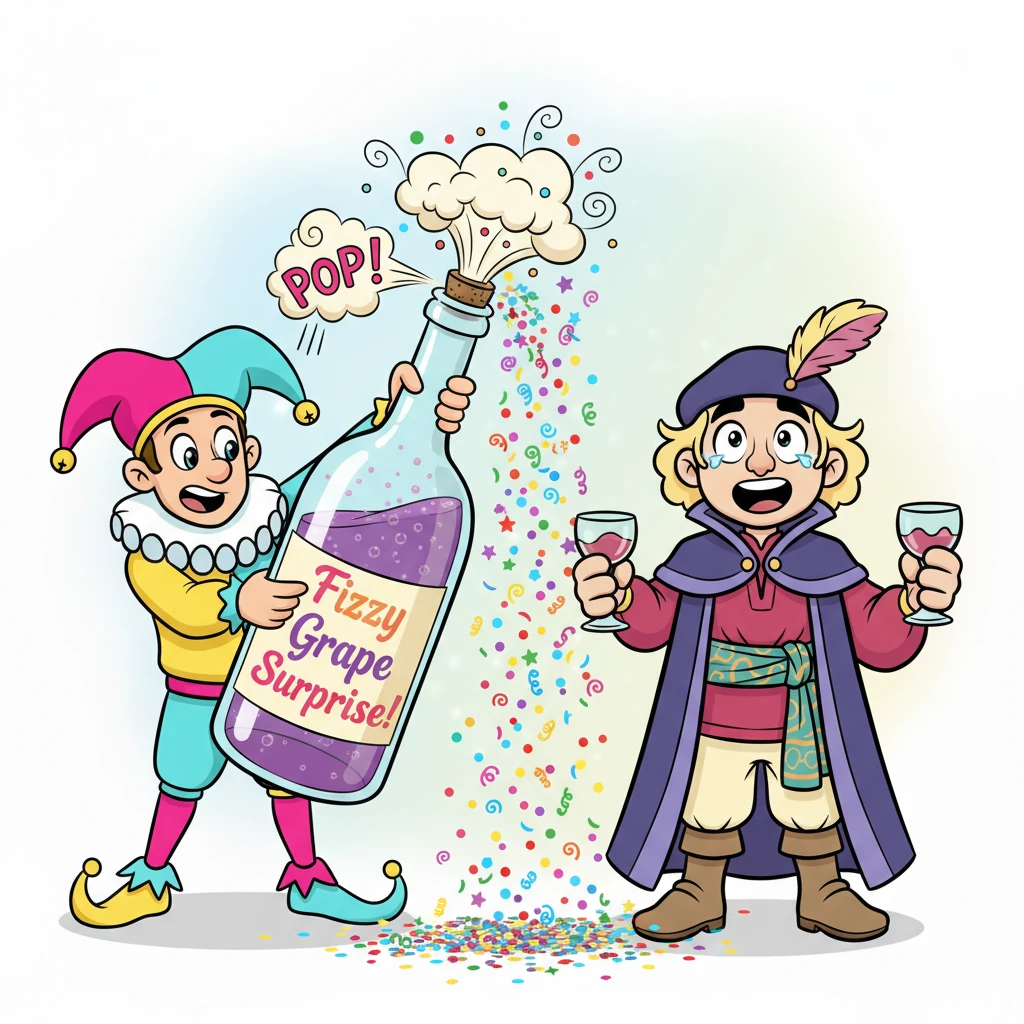
Instead of a dusty wine bottle, Monty dramatically pulled out a giant, sparkling bottle labeled "Fizzy Grape Surprise!" with a comical "POP!" Confetti burst forth, showering Ferdinand in a rainbow of colors. Ferdinand was utterly surprised, then erupted in a fit of joyful giggles.
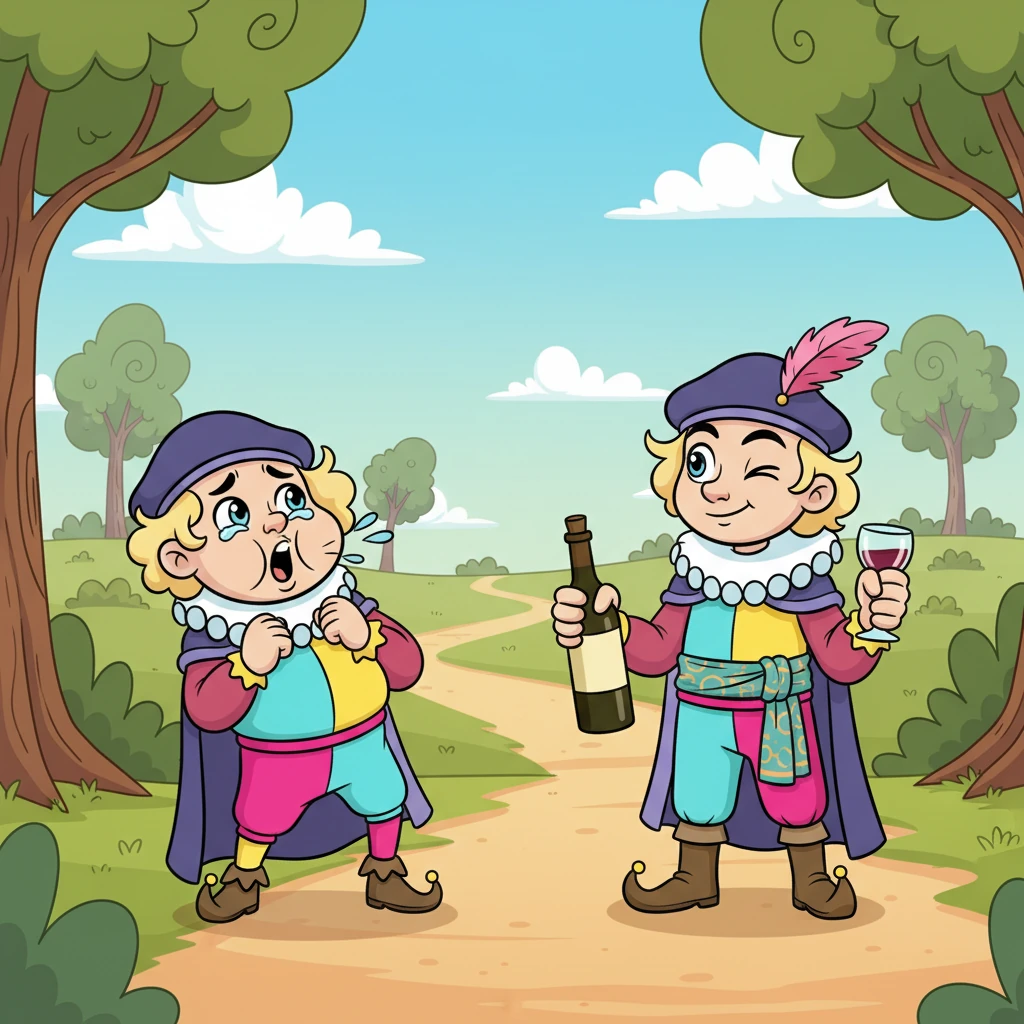
Covered in sparkling confetti, Ferdinand laughed heartily, realizing Monty's clever, good-natured prank. He playfully shook his head, admitting that sometimes, being a little less boastful made for much more fun and laughter. Monty clapped him on the back, both friends sharing a genuine, happy smile.
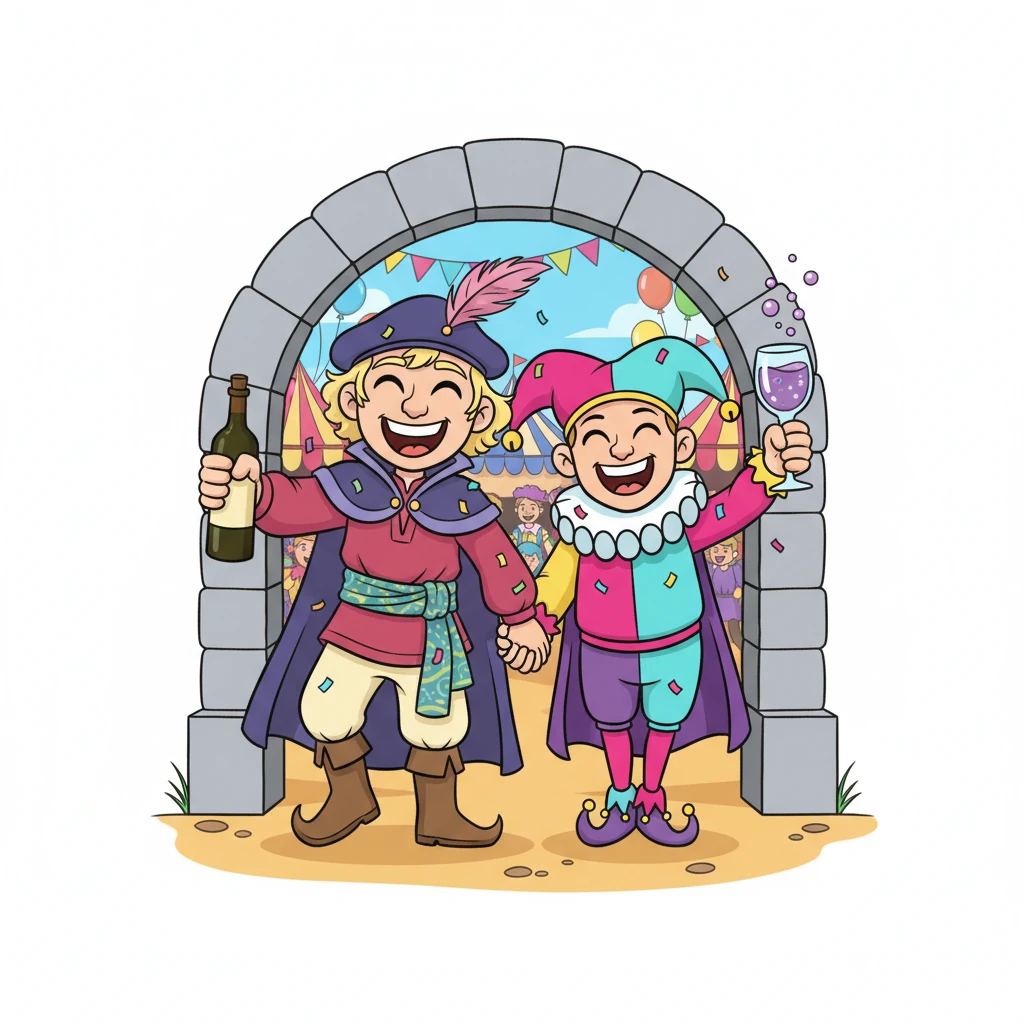
Arm-in-arm, still chuckling and covered in a few stray pieces of confetti, Monty and Ferdinand emerged from the vaults and rejoined the vibrant, noisy carnival. They celebrated their adventure by sharing a delicious, sparkling "Fizzy Grape Surprise!" drink, enjoying the festivities and their renewed, cheerful friendship.
生成提示词(登录后查看具体 Prompt)
The Cask of Amontillado The thousand injuries of Fortunato I had borne as I best could, but when he ventured upon insult I vowed revenge. You, who so well know the nature of my soul, will not suppose, however, that I gave utterance to a threat. At length I would be avenged; this was a point definitively settled — but the very definitiveness with which it was resolved precluded the idea of risk. I must not only punish but punish with impunity. A wrong is unredressed when retribution overtakes its redresser. It is equally unredressed when the avenger fails to make himself felt as such to him who has done the wrong. It must be understood that neither by word nor deed had I given Fortunato cause to doubt my good will. I continued, as was my wont, to smile in his face, and he did not perceive that my smile now was at the thought of his immolation. He had a weak point — this Fortunato — although in other regards he was a man to be respected and even feared. He prided himself on his connoisseurship in wine. Few Italians have the true virtuoso spirit. For the most part their enthusiasm is adopted to suit the time and opportunity, to practice imposture upon the British and Austrian millionaires. In painting and gemmary, Fortunato, like his countrymen, was a quack, but in the matter of old wines he was sincere. In this respect I did not differ from him materially; — I was skilful in the Italian vintages myself, and bought largely whenever I could. It was about dusk, one evening during the supreme madness of the carnival season, that I encountered my friend. He accosted me with excessive warmth, for he had been drinking much. The man wore motley. He had on a tight-fitting parti-striped dress, and his head was surmounted by the conical cap and bells. I was so pleased to see him that I thought I should never have done wringing his hand. I said to him — “My dear Fortunato, you are luckily met. How remarkably well you are looking to-day! But I have received a pipe of what passes for Amontillado, and I have my doubts.” “How?” said he. “Amontillado? A pipe? Impossible! And in the middle of the carnival!” “I have my doubts,” I replied; “and I was silly enough to pay the full Amontillado price without consulting you in the matter. You were not to be found, and I was fearful of losing a bargain.” “Amontillado!” “I have my doubts.” “Amontillado!” “And I must satisfy them.” “Amontillado!” “As you are engaged, I am on my way to Luchesi. If any one has a critical turn it is he. He will tell me ——” “Luchesi cannot tell Amontillado from Sherry.” “And yet some fools will have it that his taste is a match for your own.” “Come, let us go.” “Whither?” “To your vaults.” “My friend, no; I will not impose upon your good nature. I perceive you have an engagement. Luchesi ——” “I have no engagement; — come.” “My friend, no. It is not the engagement, but the severe cold with which I perceive you are afflicted. The vaults are insufferably damp. They are encrusted with nitre.” “Let us go, nevertheless. The cold is merely nothing. Amontillado! You have been imposed upon. And as for Luchesi, he cannot distinguish Sherry from Amontillado.” Thus speaking, Fortunato possessed himself of my arm. Putting on a mask of black silk and drawing a roquelaire closely about my person, I suffered him to hurry me to my palazzo. There were no attendants at home; they had absconded to make merry in honour of the time. I had told them that I should not return until the morning, and had given them explicit orders not to stir from the house. These orders were sufficient, I well knew, to insure their immediate disappearance, one and all, as soon as my back was turned. I took from their sconces two flambeaux, and giving one to Fortunato, bowed him through several suites of rooms to the archway that led into the vaults. I passed down a long and winding staircase, requesting him to be cautious as he followed. We came at length to the foot of the descent, and stood together on the damp ground of the catacombs of the Montresors. The gait of my friend was unsteady, and the bells upon his cap jingled as he strode. “The pipe,” said he. “It is farther on,” said I; “but observe the white web-work which gleams from these cavern walls.” He turned towards me, and looked into my eyes with two filmy orbs that distilled the rheum of intoxication . “Nitre?” he asked, at length. “Nitre,” I replied. “How long have you had that cough?” “Ugh! ugh! ugh! — ugh! ugh! ugh! — ugh! ugh! ugh! — ugh! ugh! ugh! — ugh! ugh! ugh!” My poor friend found it impossible to reply for many minutes. “It is nothing,” he said, at last. “Come,” I said, with decision, “we will go back; your health is precious. You are rich, respected, admired, beloved; you are happy, as once I was. You are a man to be missed. For me it is no matter. We will go back; you will be ill, and I cannot be responsible. Besides, there is Luchesi ——” “Enough,” he said; “the cough is a mere nothing; it will not kill me.