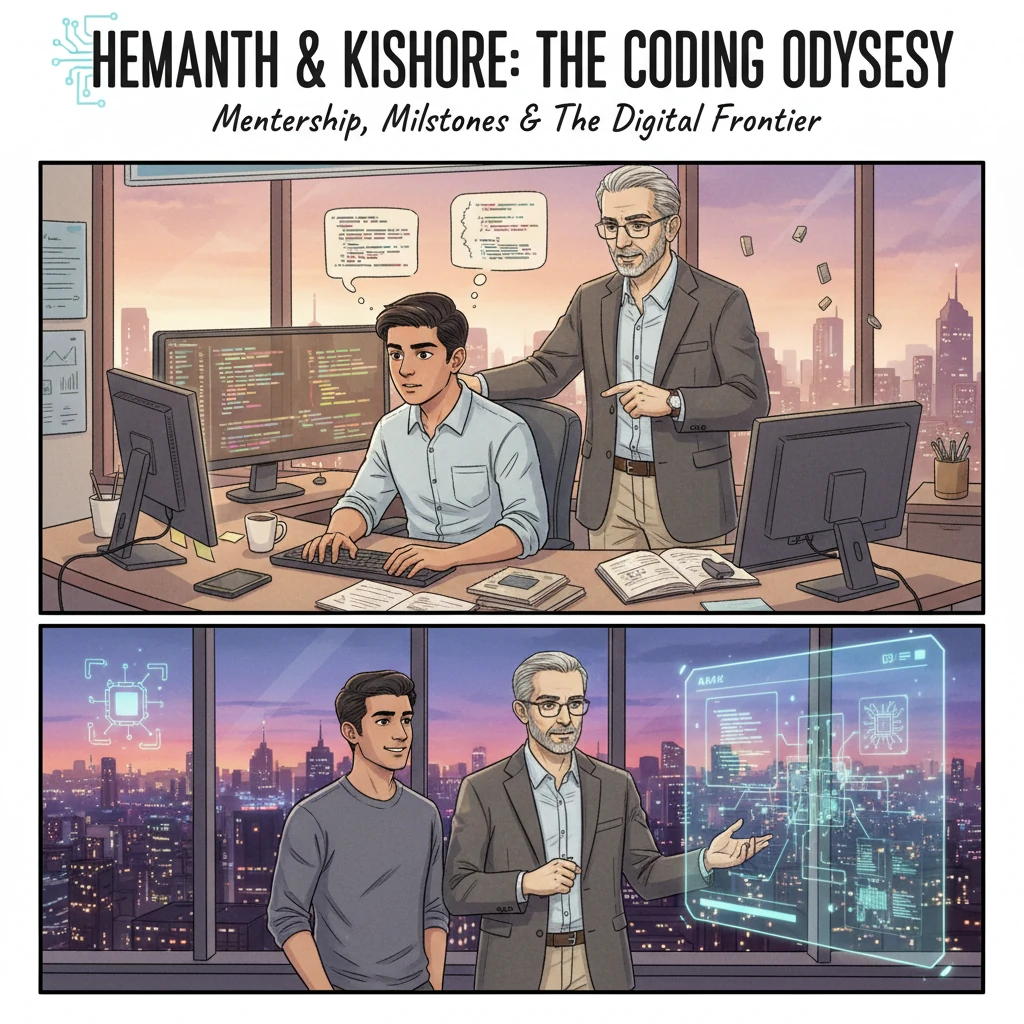
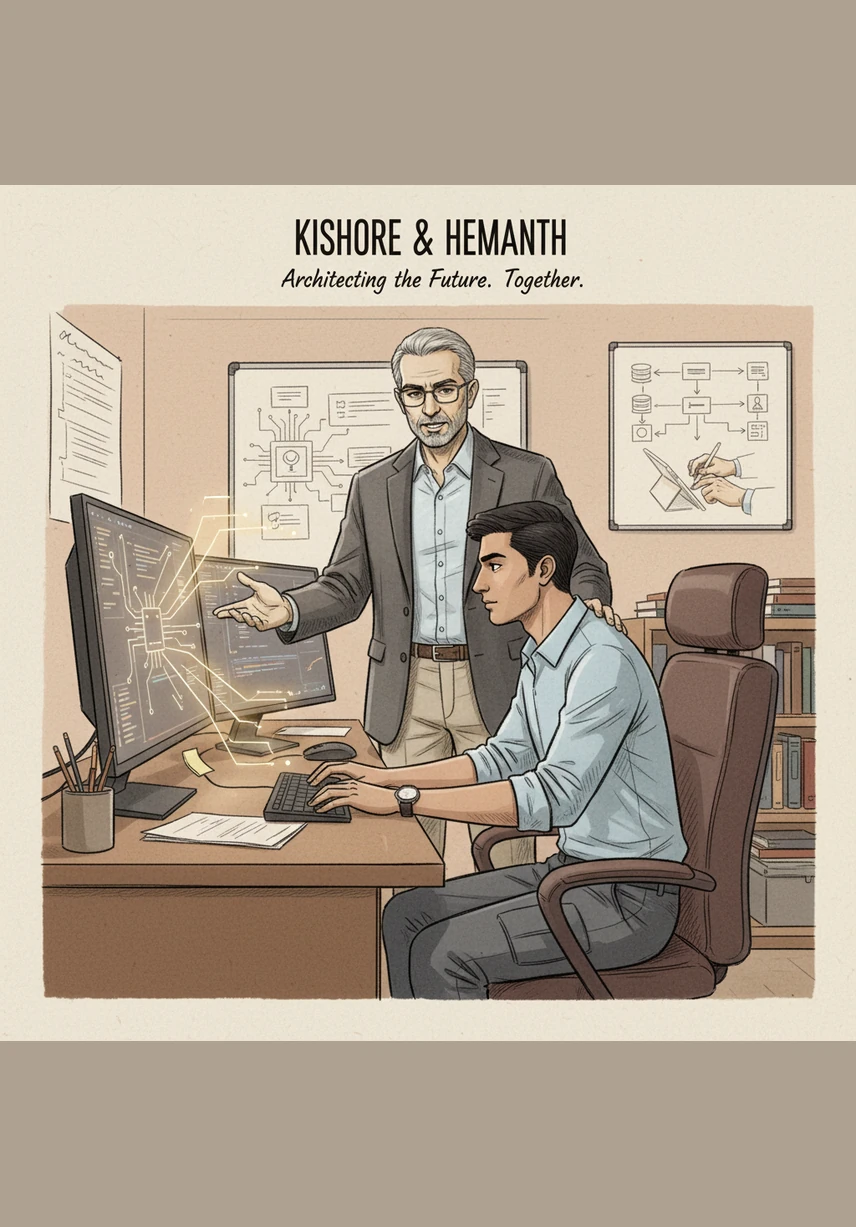
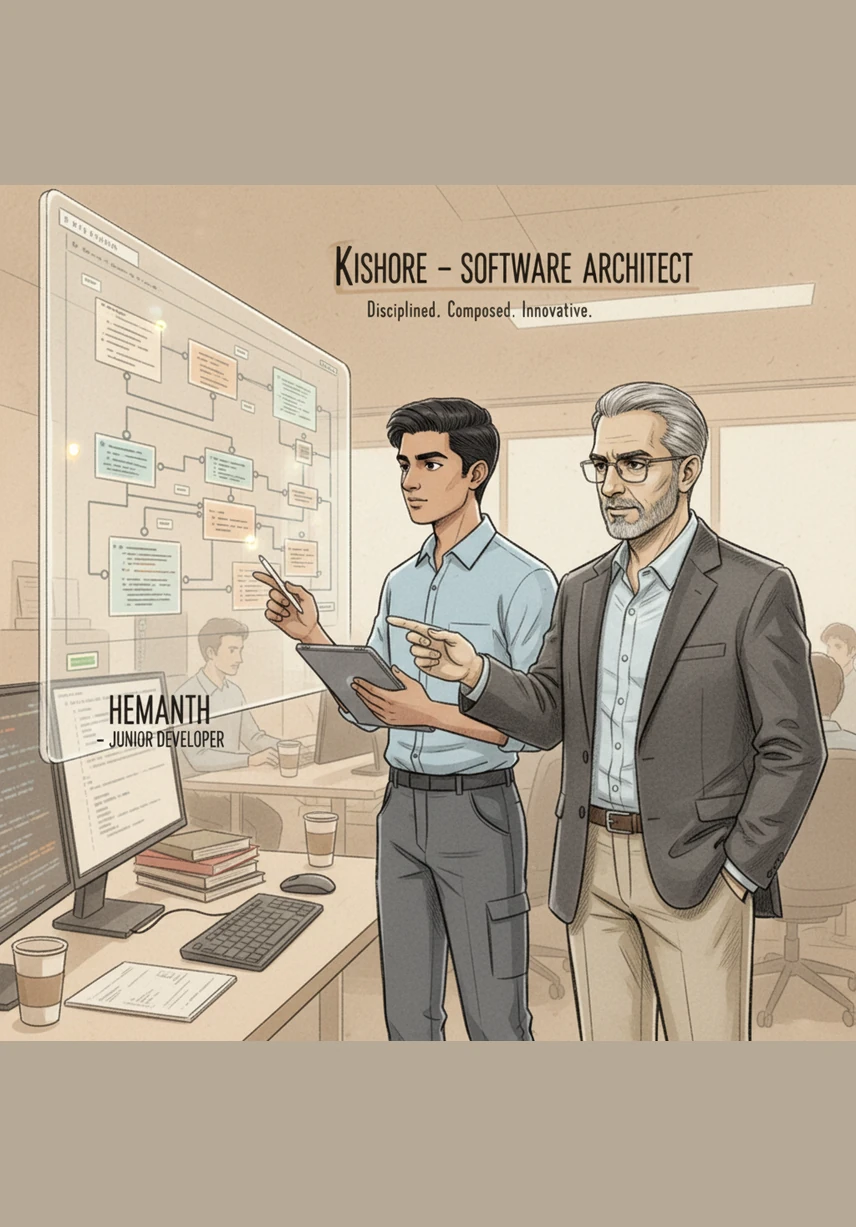
Follow the inspiring journey of Hemanth, a determined developer who dreams of changing the world through his skill-building platform, Naipunnya Lokam. Through the guidance of a wise mentor and months of rigorous training, he learns that true engineering is about more than just code—it's about mindset, resilience, and the courage to solve the impossible.
Hemanth sits in his small, dimly lit room, his face illuminated by the warm glow of multiple monitors. His desk is cluttered with hand-drawn user interface sketches and open documentation for Naipunnya Lokam, a platform he hopes will democratize skill development for everyone.
At a bustling local tech meetup, Hemanth passionately demonstrates his app to a group of interested developers. Among them is Kishore, a seasoned architect with a sharp gaze, who watches the presentation with a mix of curiosity and quiet intensity.
Kishore and Hemanth sit in a quiet corner of a modern cafe, a laptop open between them on a wooden table. Kishore points to a specific architectural function, explaining that a top-tier company looks for how an engineer handles complexity and communicates under pressure.
The mentorship intensifies as Hemanth stands before a massive whiteboard covered in complex data structures and algorithmic trees. Kishore challenges him to look past frameworks and master the fundamental logic that makes all technology function.
In a late-night study session, Kishore sketches a massive cloud network on the board, asking Hemanth how to handle ten million concurrent users. Hemanth pauses, then begins to draw a distributed system, his confidence growing as he designs a scalable solution.
Hemanth practices his communication skills, standing tall and explaining a complex architectural decision to an imaginary audience. Kishore listens carefully, teaching him that the ability to simplify the complex for others is the true mark of a leader.
For six months, Hemanth immerses himself in a world of open-source contributions and high-pressure mock interviews. He spends hours talking through his thought process out loud, turning his small room into a professional training ground for the ultimate challenge.
Inside the sleek glass walls of a high-tech office, Hemanth faces a panel of interviewers during a grueling technical round. He remains calm, hearing Kishore's voice in his head as he breaks down a difficult problem into elegant, modular solutions on the whiteboard.
Back at home, a notification pings on Hemanth's phone, lighting up the dark room with a bright flash. He stares at the screen in a moment of pure disbelief and joy as he reads the simple, life-changing subject line: Welcome to Google.
On his first day at the global tech giant, Hemanth looks at a small photo of his old whiteboard where Kishore’s final advice is written. He realizes that while he has reached his goal, the journey of a student never truly ends as long as there are problems to solve.
Generation Prompt(Sign in to view the full prompt)
Scene 1: The Vision Hemanth sat in his small room, surrounded by sketches of user interfaces and open tabs of documentation. He wasn’t just building another app; he was building Naipunnya Lokam, a platform designed to democratize skill development. He believed in the power of structured learning, but the path to professional success felt like a dense, foggy forest. He had the skills, but he lacked the roadmap. Chapter 2: A Chance Encounter One afternoon, at a local tech meetup, Hemanth met Kishore, a seasoned software architect who had spent years working on high-scale systems at global tech firms. Watching Hemanth demo his app, Kishore saw something rare: not just technical competence, but a genuine passion for solving real-world problems. "Your code is clean, Hemanth," Kishore said, pointing to a specific function in the app's architecture. "But at a company like Google, they look for more than just code. They look for how you think, how you handle complexity, and how you communicate your solutions under pressure." Chapter 3: The Guidance Kishore became a mentor, and the training was rigorous. He set a new standard for Hemanth’s daily routine: Deepen the Foundations: "Don't just use frameworks," Kishore advised. "Understand the data structures and algorithms that make them work. That is the language of Google." System Design Thinking: They spent weeks whiteboarding. Kishore would throw impossible scenarios—what happens if ten million users hit your server at once?—and Hemanth had to design scalable solutions. The "Googley" Factor: Kishore emphasized that brilliance without collaboration was useless. He had Hemanth practice explaining his complex code in simple, concise terms to non-technical stakeholders. Chapter 4: The Preparation For six months, Hemanth lived by a strict schedule. He contributed to open-source projects to understand how to work within massive, distributed codebases. He simulated high-pressure interviews with Kishore, learning how to walk through his thought process out loud—an essential skill for solving problems on a whiteboard. When the invitation for the Google technical interview finally arrived, Hemanth wasn't just a coder anymore; he was an engineer ready to solve problems at scale. Chapter 5: The Breakthrough The interview was grueling. He faced complex algorithmic challenges and deep-dive system design questions. But as he looked at the problems, he didn't panic. He heard Kishore’s voice in his head: “Think out loud. Clarify the requirements. Build a modular solution.” When he faced a roadblock, he didn't freeze. He systematically narrowed down the constraints, explained his trade-offs clearly, and built an elegant solution. A few weeks later, the email arrived. The subject line was simple: "Welcome to Google." Chapter 6: The Legacy Hemanth walked into the Google office on his first day, the lessons of Naipunnya Lokam and the guidance of Kishore tucked away in his professional toolkit. He realized then that he hadn't just gotten a job; he had learned how to think, how to learn, and how to build technology that could change the world. And back in his room, he kept his old whiteboard, with Kishore’s final piece of advice written in permanent marker: "The best developers never stop being students. Stay curious, stay humble, and keep building."